PEEK and PEKK
Properties
- Price: $172 - $347 / lb
- high heat resistance (thermal resistance)
- Lightweight
- stronger than many metals
- wear resistance
- chemical resistance
- UL rated flame resistance
- biocompatibility
- PEKK is more flexible than PEEK
Printing Settings
| Setting | PEEK | PEKK |
|---|---|---|
| Nozzle Temp | 370 – 410 °C | 345 – 385 °C |
| Bed Temp | 120 – 160 °C | 120 – 160 °C |
| Chamber Temp | 120 – 160 °C (closed & heated chamber required) | 70 – 140 °C (lower end possible with PEKK blends) |
| Print Speed | 15 – 50 mm/s | 15 – 60 mm/s |
| Cooling Fan | Off | Off or very low (~10%) |
| Layer Height | 0.1 – 0.25 mm | 0.1 – 0.25 mm |
| Nozzle Type | Hardened steel or ruby-tipped | Same |
| Build Surface | Garolite, PEI, or carbon fiber plates with adhesive or raft | Same |
Description
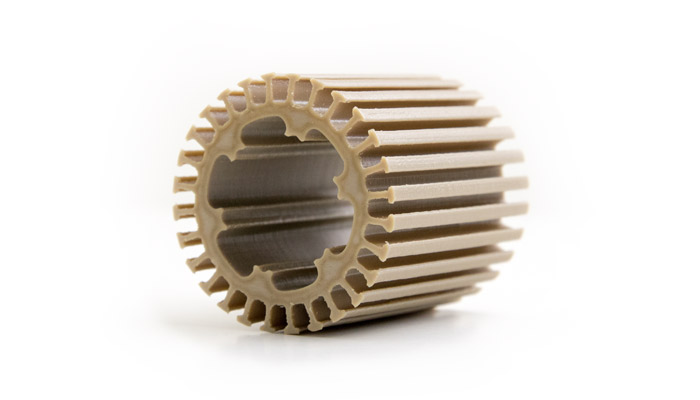
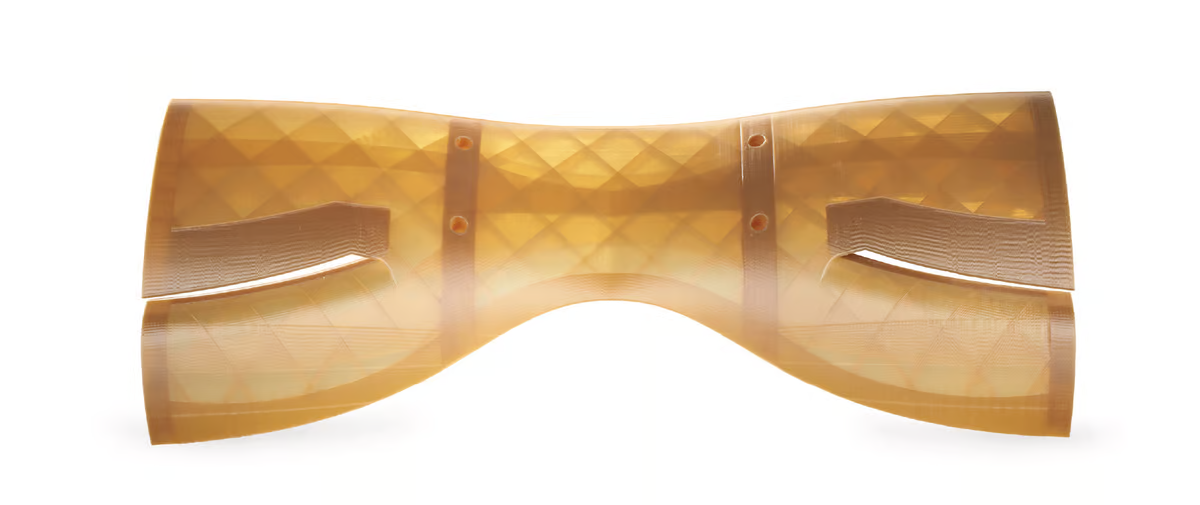
Polyether ether ketone (PEEK and PEKK) are a high-performance thermoplastic known for their exceptional chemical and temperature resistance, making them ideal for aerospace and medical applications. Polyether-ester-ketone (PEEK) and polyether-ketone-ketone (PEKK) are very similar in composition.
In 3D printing, PEEK must be printed in a high temperature environment in order to control the crystallization process. Once it cools, part of it crystallizes, changing its density. It requires an extruder that can reach 400°C, a chamber heated to 120°C, and a build plate heated to 230°C to ensure proper part release at the ending and prevent warping.
It is used in many industries to replace certain metals. Its flame resistance and high strength-to-weight ratio makes it an interesting material for aerospace. It outperforms ULTEM in mechanical strength.
Material Sources
- Victrex PEEK
- Ketaspire
- Treed Filaments PEEK NAT
- Treed Filaments PEEK CF
- Markforged Vega™: carbon fiber filled PEKK, prints on Markforged FX20
- Stratasys Victrex AM™ 200, PEEK-Based FDM Thermoplastic
Applications
- Medical sector for its sterilizability, biocompatibility - similar properties to human bone. FossiLabs and other medical device companies use PEEK for customized medical devices
- Aerospace for its flame resistance and high strength-to-weight ratio. PEEK parts have been sent to space
3D printers that can print it
- The Stratasys Fortus 450mc can print Antero 800NA,
- The Markforged FX20 can print Vega™, a carbon fiber filled PEKK
- AON M2+
- INTAMSYS FUNMAT PRO 610HT or Funmat HT
- MiniFactory Ultra 2
- Apium P400
- CreatBot PEEK-300
- More printers that can use it at All3DP
Sources
- Printing with PEEK
- All you need to know about PEEK for 3D printing
- PEEK vs PEKK: Which high performance material should I choose?
- All you need to know about PEEK for 3D printing (3D Natives)
- All you need to know about PEKK for 3D printing
See also Ultem, another high-performance thermoplastic.