Amateur Radio
History of Radio
The theoretical foundation of radio waves was laid by James Clarks Maxwell. Heinrich Hertz confirmed the existence of these waves. Tesla and Marconi both are credited with inventing methods of long distance broadcast of radio waves. The patent was stolen from Tesla much later. The work of both have been foundational to the development of radio technology.
The first radio broadcast was made on Christmas Eve in 1906 by R.A. Fessenden. Dr Lee de Forest invented a vacuum tube amplifier to amplify weak radio signals.
Modern Radio Technology
- 1G - first analog mobile communication for calls only
- 2G - text messaging was introduced
- 3G - Mobile data introduced
- 4G - Mobile data focused
- 5G - Improved compression of data than previous
- Zigbee - 900 MHz range radio tech for home automation technology
- LoRaWAN - a low-powered low range tech for IoT applications around 868 - 919 MHz
- SigFox - a French company providing global low-powered wide-range area LPWAN for IoT applications - sub-GHz ISM bands
- WiFi HaLow for IoT - sub-1 GHz, narrow band of OFDM channels - long range (approx 1km), penetrates walls, supports coin cell devices for months/years,
- NBIoT - Narrow Band IoT - sub-GHz bands - long -range low powered communications,
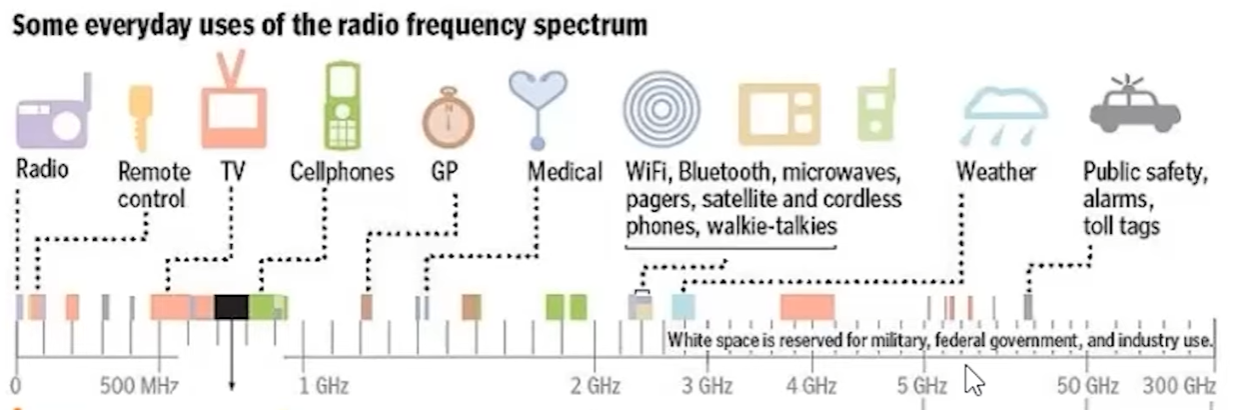
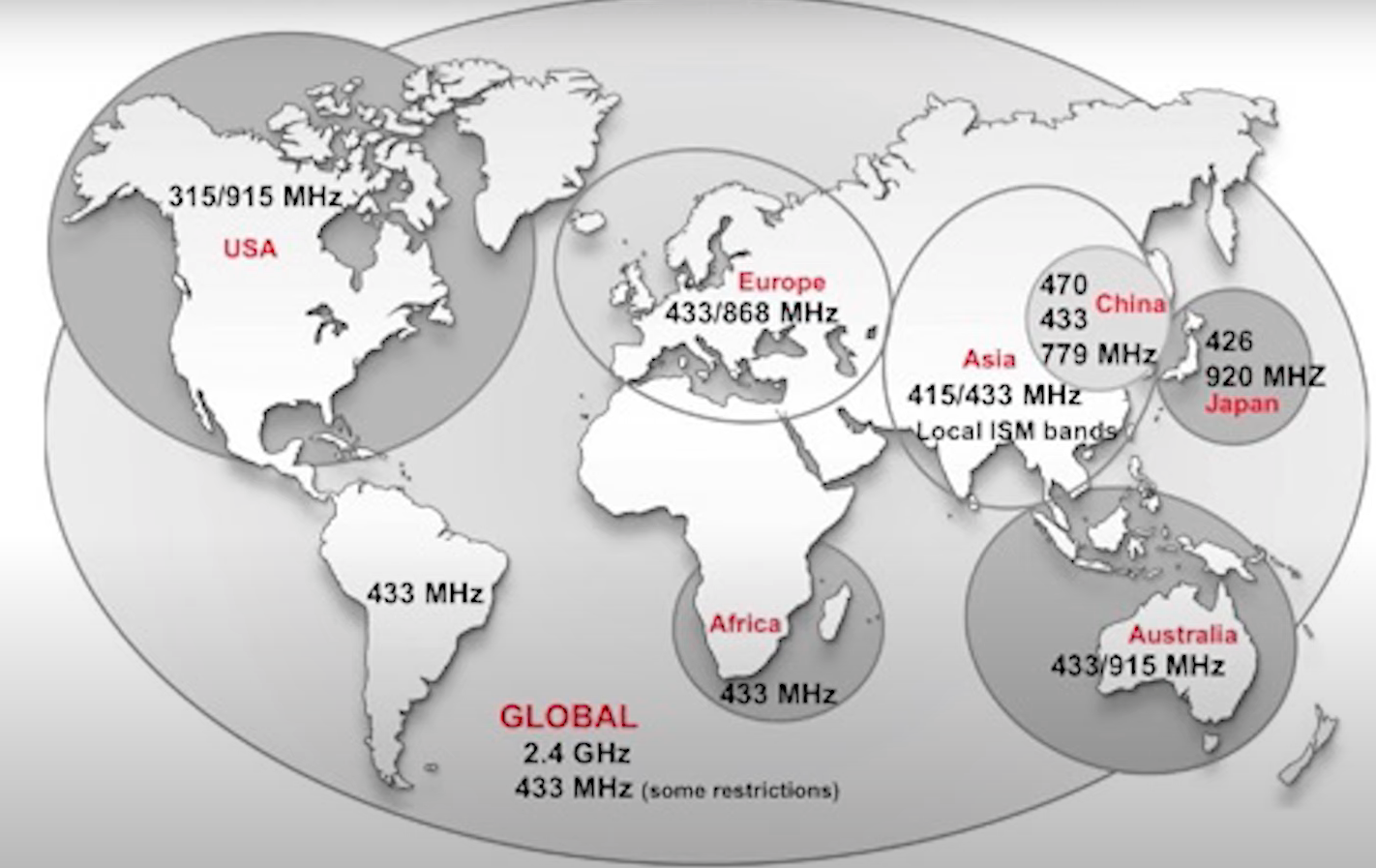
Free ISM Sub-GHz bands around the world
Landmarks
- Maritime Radio Museum, Pooint Reyes Station, CA
- Radio Museum, Alameda, CA
Learning resources
- Video: Properties of Waves is a classic video made by Dr. J.N. Shive at Bell Labs.
Getting Started in Ham Radio Easy (YouTube) - Ohms Law
- Antenna Notes for a Dummy a Wayback Machine-archived version of a collection of notes about radio - very old looking but a good collection of info - some links may not work
- YouTube
- Ham Radio Crash Course
- DX Commander
- Thomas Witherspoon QRP mostly?
- Ham Radio Prep
- Unlicensed Radio Services for ways to use radios that don't require taking a test
Books
- ARRL Handbook for Radio Communications (6 volumes)
- ARRL Antenna book for Radio Communications $49
- ARRL Basic Antennas - Understanding Practical Antennas and Designs $29
Licensing
The Federal Communications Commission (FCC) accredits Volunteer Examiner Coordinators (VEC) who administers the exams for amateur radio license. There are three sequential levels of licensing exams currently:
- Technician Class
- General Class
- Amateur Extra Class.
Prospective amateur radio operators are examined on understanding of the key concepts of electronics, radio equipment, antennas, radio propagation, RF safety, and the radio regulations of the government granting the license. [1]
License prep:
- Hamstudy.org - very helpful way to study
- Ham License Prep (YouTube Playlist)
- Fast Track series on Amazon
- FCC Regulations for Amateur Radio
Find an exam session in your area
Things to do before testing day
- Register on FCC website,
- Register a new FRN. Your name, address, SSN, phone, and email address will be associated with this number. Some consider using a P.O. Box because it is possible to view your address in the FCC database.
- Exam fee $15
- FCC will request $35 to process the new license
Amateur Band Plan

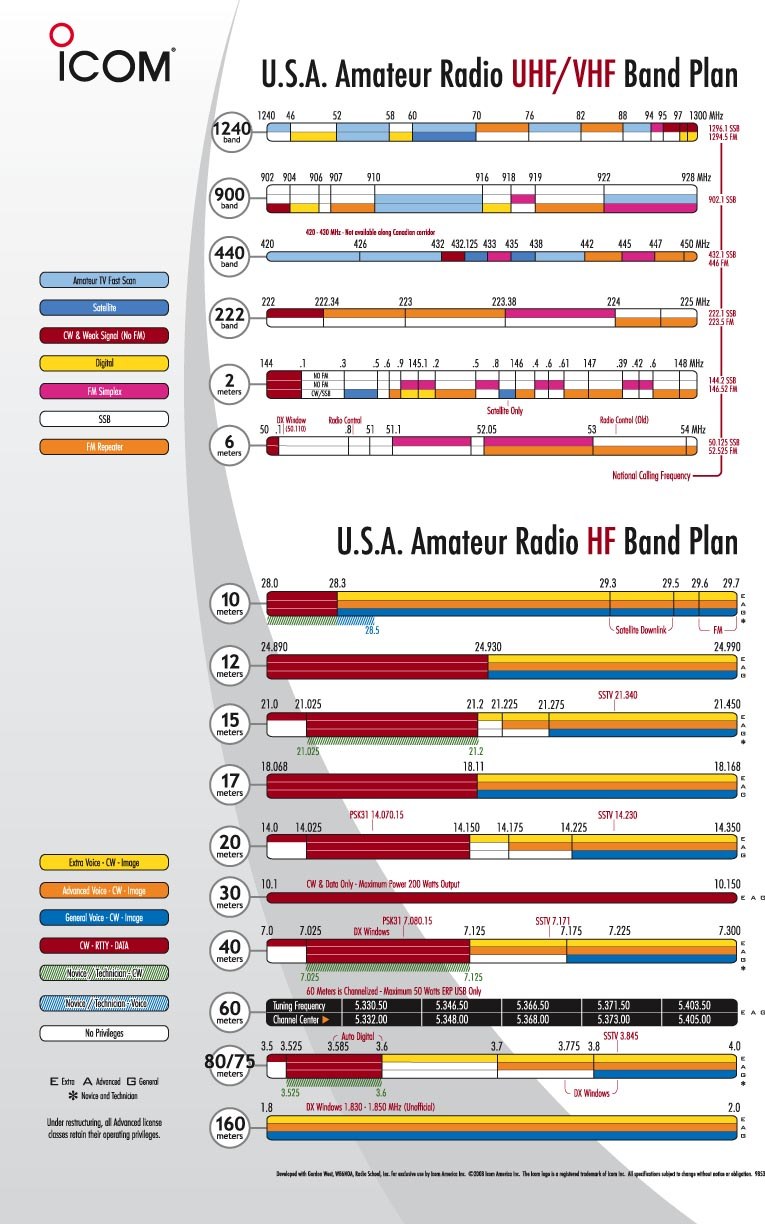
Specific Frequencies
National Calling Frequencies
- 2m band: 146.250 MHz simplex
- 1.25m band: 223.500 MHz simplex
- 70cm band: 446.000 MHz simplex
Cal Berkeley Calling Frequency: 146.430 Mhz simplex
California Repeaters
ADS-B - Aircraft transponder data:
Adsbexchange - website showing transponder collection data
Bands
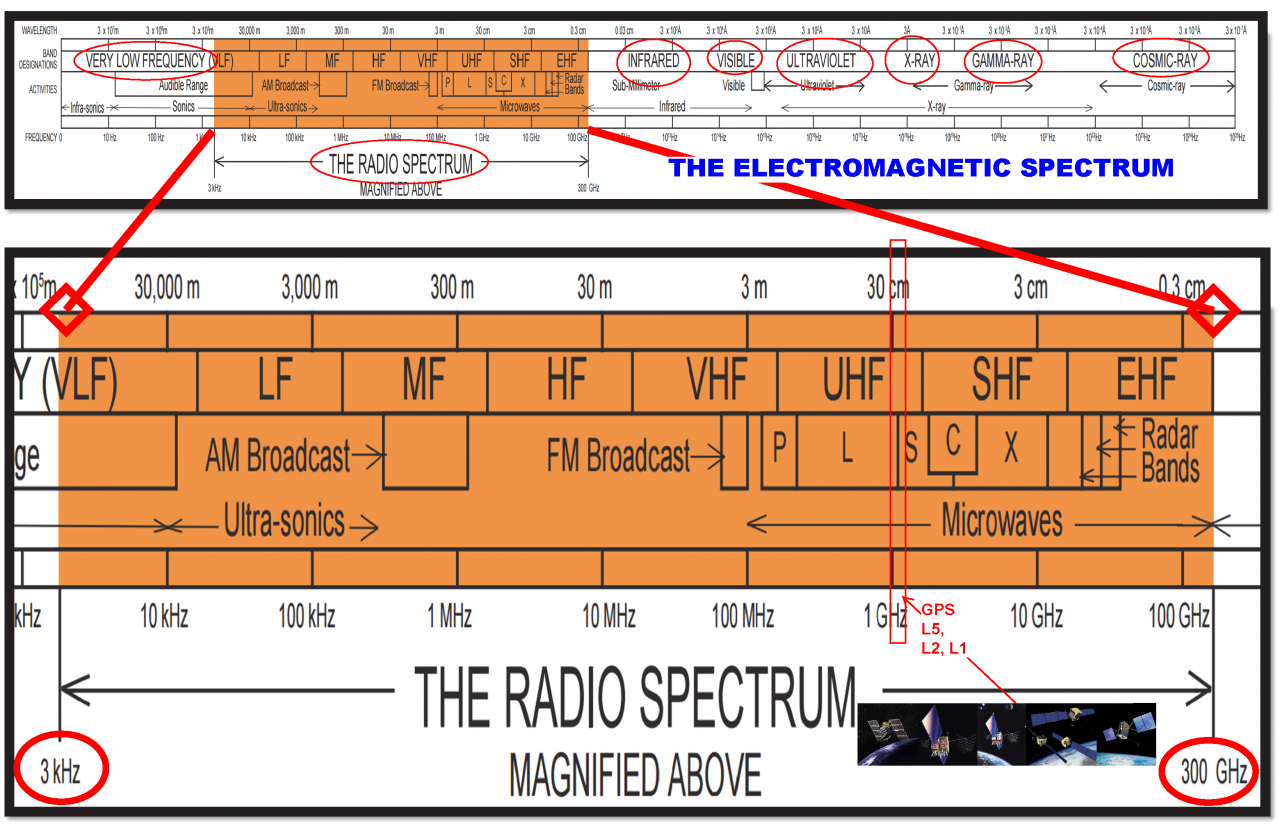
Bands to avoid transmitting on
A system of propagation beacon stations operates on these frequencies:
- 14.100
- 18.110
- 21.150
- 24.930
- 28.200 MHz
See also RadioReferenceWiki
RF Safety
If you find that your station shows RF energy in excess of permissible limits, you must take action to prevent human exposure to the excessive RF fields, which may cause tissue damage and RF burns.
Radio Frequency Safety (FCC.gov)
RF Radiation and Electromagnetic Field Safety (ARRL.org)
Indirect Hazards
RF Exposure Calculator (ARRL)
RF exposure calculator (hintlink.com)
FCC OET Bulletin 65 - FCC Guidelines for Human Exposure to Radiofrequency Electromagnetic Fields
Reducing the total RF exposure may be accomplished by reducing any or a combination of factors:
- Reduce power
- Move your antenna
- Move the RF source farther away from possible contact
- Improve shielding or insulation.
Morse Code (CW)
Learning CW
- LCWO.net a web based Koch Method based learning app
- Morse Code With Google
- Learn Morse Code
- Morse Mania - an iOS app
- IZ2UUF Morse Koch CW Android app
- Long Island CW Club
KOCH Method - Set character speed to 20 WPM but with extra spacing between letters and practice. As you become comfortable hearing each letter, start reducing spacing between letters.
cwmorse.us A small business that makes and sells keys at a very reasonable price
Morse Mania - iPhone app that teaches receiving and sending
Digital Modes
-
RTTY - Radio Teletype was the first digital mode
-
APRS
-
PSK-31 - "phase shift keying, 31 baud"
-
WSJT-X is a computer program used for weak-signal radio communication. Originally released in 2001 and has had multiple revisions.
- FSK441 - the first mode introduced in WSJT, which is designed to support communication using "meteor scatter", streaks of radio-reflecting ions created by trails of meteors in the ionosphere when they enter the atmosphere. Used generally on 2m and 70cm bands.
- FT8 - a frequency shift keying digital mode available in WSJT
- JT65 - low power digital mode for use on HF with very low power, such as those found on troposcatter or Earth-Moon-Earth ("moonbounce") paths
-
JS8 - JS8Call is an experiment to test the feasibility of a digital mode with the robustness of FT8, combined with a messaging and network protocol layer for weak signal communication on HF, using a keyboard messaging style interface. It is not designed for any specific purpose other than connecting amateur radio operators who are operating under weak signal conditions. JS8Call is heavily inspired by WSJT-X, Fldigi, and FSQCall and would not exist without the hard work and dedication of the many developers in the amateur radio community.
Pskreporter.info is a project to automatically gather reception records of digimode activity and then make those records available in near realtime to interested parties
Kc2g
Time syncing methods
- Software: Dimension 4,
- NTP protocol
- GPS
Programming
- Hamlib - provides a consistent API for controlling radios
KiwiSDR
- rx-tx.info - map of SDR receivers
- KiwiSDR map of listed KiwiSDR receivers
Clubs and Groups
- Parks on the Air (POTA)
- See also Parks On The Air
- Video about POTA
- W6BB UC Berkeley Amateur Radio Club
- W6BB on QRZ.com
- Weekly Net on 442.275+ Tone 103.5 Hz (WA6ZTY - LBNL Repeater)
- RFS Shack - shack at Richmond Field Station
- Cory Hall shack - UHF/VHF satellite tracking
- Transmitter Hunting in SF Bay Area
- SF Radio Club
- Oakland Radio Communication Association
- Easy Bay Amateur Radio Club (W6CUS)
Forums
Contact Logs
Local Stations
Atmospheric Propagation
The sun emits electromagnetic radiation and matter as a consequence of the nuclear fusion process. Electromagnetic ultraviolet radiation ionizes the F region, soft X-rays ionize the E region, and hard X- rays ionize the D region. Solar matter (which includes charged particles--electrons and protons) is ejected from the sun on a regular basis, and this comprises the solar wind. On a "quiet" solar day the speed of this solar wind heading toward Earth averages about 400 km per second.
Sunspots are areas on the sun associated with ultraviolet radiation. Thus they are tied to ionization of the F region.
Sunspots come and go in an approximate 11-year cycle. The rise to maximum (4 to 5 years) is usually faster than the descent to minimum (6 to 7 years). At and near the maximum of a solar cycle, the increased number of sunspots causes more ultraviolet radiation to impinge on the atmosphere. This results in significantly more F region ionization, allowing the ionosphere to refract higher frequencies (15, 12, 10, and even 6 meters) back to Earth for DX (long distance) contacts.[2]
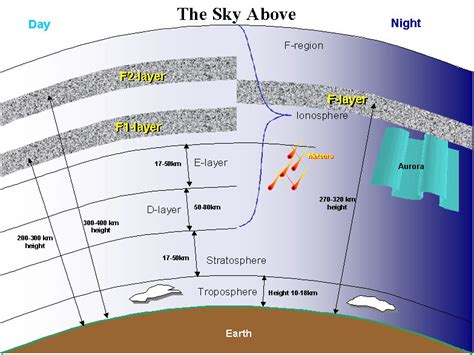
During the day, 40-, 60-, 80-, and 160-meter bands are more difficult because the D region absorbs signals during daylight hours. This is due to X-ray flares.
During the high point in the 11-year solar cycle, 15, 12, 10, and 6 are more effective during the day.
Maximum usable Frequency (MUF) - the highest radio frequency that can be used for transmission between two points on Earth by reflection from the ionosphere (skywave or skip) at a specified time, independent of transmitter power. This index is especially useful for shortwave transmissions. See this website, prop.kc2g.com, where MUF data has been collected into an interpolated map to see how MUF changes around the world at any given time.
Radios
See Radios
Antennas
See Antennas
Accessories
Terms
Useful links while operating
Footnotes
various authors. "Amateur Radio". Wikipedia. ↩︎
Carl Luetzelschwab. What the numbers mean, and propagation predictions - a brief introduction to propagation and the major factors affecting it. ARRL. ↩︎