Methods of Travel in Japan
Methods
- Subway
- Buses
- JR Trains (Japanese Rail)
- Taxis
- Biking in Japan
IC cards
You preload money onto An IC card and tap in/out on trains, subways, and buses. It deducts the exact fare automatically. They are interoperable nationwide. A Suica works in Kyoto. An ICOCA works in Tokyo. You do not need separate cards per city.
The Main IC Cards
These are regionally branded but function almost identically.
| Region | Card | Operator |
|---|---|---|
| Tokyo | Suica | JR East |
| Tokyo | PASMO | Private rail operators |
| Kansai (Kyoto/Osaka) | ICOCA | JR West |
You can add Suica or PASMO directly in Apple Wallet.
IC Cards also work with:
- Convenience stores (7-Eleven, Lawson, FamilyMart)
- Vending machines
- Some restaurants
- Lockers
- Taxis (most urban ones)
Japan Rail Pass (JR Pass)
The Japan Rail Pass (JR Pass) is a ticket for foreign visitors that allows unlimited travel on the Japan Railways network, including bullet trains, for a set number of days. JR Pass may not be cost-effective unless doing extensive long-distance travel.
| JR Pass Length | Cost |
|---|---|
| 7 day pass | ¥50,000 (~$332) |
| 14 day pass | ¥80,000 (~$532) |
Trains
- get train routing from Google Maps or various Japanese apps that specialize in this
- Last trains ~12am in Tokyo
Bullet Train (Shinkansen)
The Shinkansen, or bullet train, operates several high-speed routes across Japan, including the Tōkaidō Shinkansen (Tokyo to Osaka), the Tōhoku Shinkansen (Tokyo to Aomori), and the Kyushu Shinkansen (Hakata to Kagoshima). These routes connect major cities and regions, allowing for fast and efficient travel throughout the country.
Train options on the Tokaido line (Tokyo ↔ Kyoto ↔ Osaka):
- Nozomi: Fewest stops and fastest option (not covered by JR Pass)
- Hikari: More stops
- Kodama: All stops (slowest)
Book tickets:
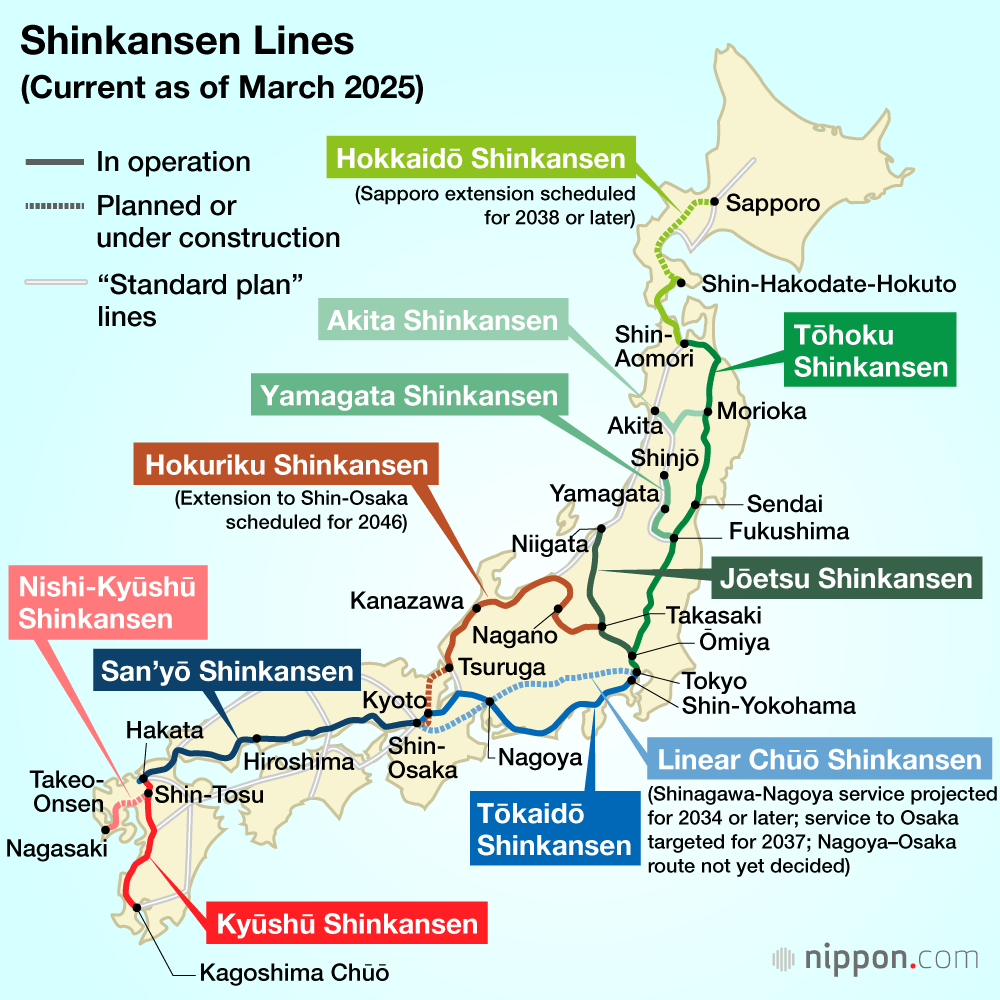
Shinkansen Lines